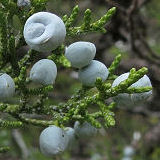
Leaves: Scaled, groups of 3, some awl-like
Cones: Small blue berries
Bark: Brown, becoming gray, flaky
Where: Dry areas
These conifers grow on the eastern slopes of the Cascades and in other mountains to the east.
|
|
Leaves: Scaled, groups of 3, some awl-like Cones: Small blue berries Bark: Brown, becoming gray, flaky Where: Dry areas |
|
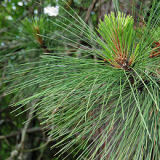
Needles: Long, bundles of 3 Cones: Egg shaped with prickles on scales Bark: Orange puzzle pieces Where: Below 5000 ft (1500 m) |
|
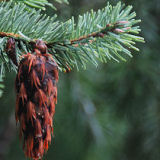
Needles: Thin, soft points, all around twig Cones: 3-pointed bracts Bark: Brown, deep furrows on large trunks Where: Below 5000 ft (1500 m) |
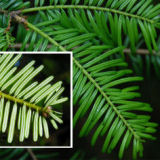 |
Needles: Flat & flattened on twig, white lines below Cones: Upright at tree top, purple Bark: Smooth, gray, small furrows on large trunks Where: Below 5000 ft (1500 m) |
|
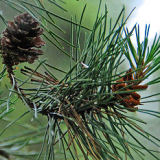
Needles: Bundles of 2 Cones: Egg shaped Bark: Dark gray, scaly Where: Along the coast and above 3000 ft (900 m) in the mountains |
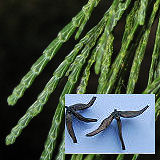 |
Needles: Long, flat scales Cones: Shaped like a duck's bill Bark: Brown, deep furrows Where: Dry areas of Cascades |
|
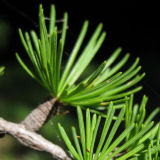
Needles: Bundles of 25 Cones: whiskery bracts Bark Flaky scales, furrowed Where: East of the Cascade crest, up to 6000 ft (1800 m) |
|
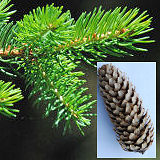
Needles: Sharp, thin, 4-sided, all around twig Cones: Paper-thin scales Bark: Dark gray scales Where: East of the Cascade crest above 3000 ft (900 m) |
|
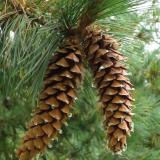
Needles: Bundles of 5 Cones: Up to 10" (25 cm) long, curved Bark: Dark gray scaly plates Where: Up to 5000 ft (1500 m) |
|
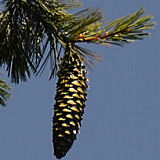
Needles: Bundles of 5 Cones: Large, Up to 20" (50 cm) long Bark: Gray-brown with furrows Where: Cascades south of the 45th parallel |
These conifers grow near the timberline.
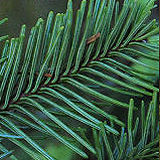 |
Needles: Bent like hockey sticks Cones: Upright at tree top, whiskery bracts Bark: Gray-brown becoming furrowed Where: Above 2000 ft (600 m) in western Oregon and Washington |
|
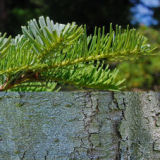
Cones: Upright at treetop Bark: Smooth, gray scaly plates Where: Above 3000 ft (900 m) in western Oregon and Washington |
|
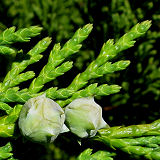
Leaves: Flat, scaled, prickly Cones: Round Bark: Gray-brown, shreddy strips Where: Above 3000 ft (900 m) |
|
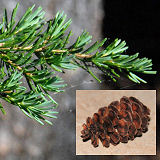
Needles: Short, flat, spread in all directions Cones: 2" (5 cm) long, rounded scales Bark: Gray, small deep furrows Where: Above 4000 ft (1200 m)
|
|
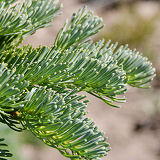
Needles: Curved upward, white lines above & below Cones: Upright at tree top, purple Bark: Smooth, gray Where: Near the timberline |
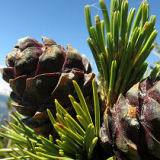 |
Needles: Bundles of 5 Cones: Up to 3" (8 cm) long, closed when mature Bark: Light gray, scaly Where: At the timberline |
These conifers are rare east of the Cascade crest.
|
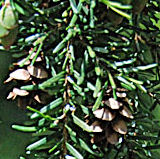
Needles: Short, flat, irregular, white lines below Cones: Small. Rounded scales Bark: Gray, small furrows Where: Below 4000 ft (1200 m) |
|
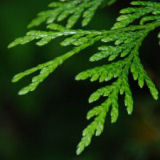
Leaves: Flat, scaled, white butterflies below Cones: Tiny. Rose-shaped Bark: Brown, stringy Where: Wet areas below 5000 ft |
|
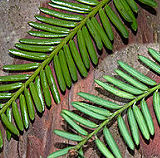
Needles: Flat, flattened on twig, lighter green underneath Fruit: Red berry-like aril Bark: Thin gray scales over smooth red bark Where: Wet shady areas below 5000 ft (1500 m) |
|
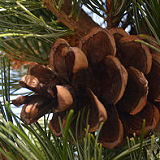
Needles: Bundles of 5 Cones: Up to 7" (18 cm) long, open when mature Bark: Light gray, becoming brown and furrowed Where: Wallowa Mountains |
|
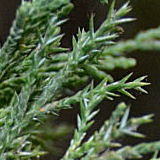
Needles: Scaled, in opposite pairs Cones: Small blue berries Bark: Brown with shredded scales Where: Dry areas in mountains east of the Cascades |
|
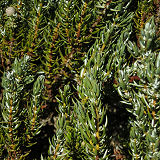
Needles: Awl shaped, Cones: Small blue berries Bark: Brown Where: Alpine areas growing as a low, spreading shrub |