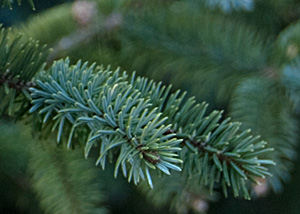
Needles: The needles are thin and stick out all around the twig like a bottle brush. You can easily identify a spruce by touching the needle points, which are quite sharp. Also, spruce needles are unique in growing from short, woody pegs that remain after the needles fall off.
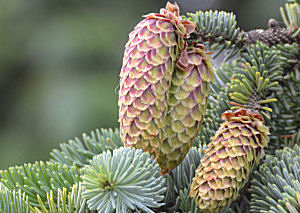
Cones: The cones are 3 inches (8 cm) long and have paper-thin scales.
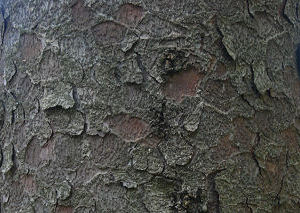
Bark: The bark is gray, thin, and breaks into scales on large trees.The base is buttressed on large trees.
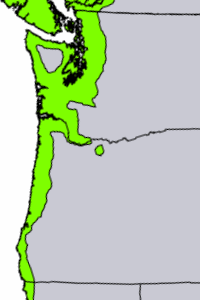
Where it grows: Sitka spruce grows along the Pacific Coast and in the coastal forests to elevations of several hundred feet. At higher elevations, it is usually replaced by western hemlock. It also grows along coastal rivers some miles inland and along the Columbia River as far east as the Columbia Gorge. Near the Coast, the wind often deforms the trees, as in the photo below.
Sitka spruce at Hoyt Arboretum
Similar tree: Engelmann spruce grows in the Cascade Mountainss. The best way to distinguish Sitka spruce from Engelmann spruce is by location. You can also distinguish them by rolling a needle between your fingers. The flat Sitka needle will not roll, but the square-shaped Engelmann needle will.
Uses: Like other spruces, Sitka spruce is used for making paper, lumber, and fine musical instruments such as guitars and violins. It has also been used in making airplanes, oars, and boats.
Names: Sitka spruce is named after Sitka, Alaska, and it is the state tree of Alaska. Sitchensis refers to Sitka, Alaska. Other common names: tideland spruce, coast spruce, and yellow spruce.
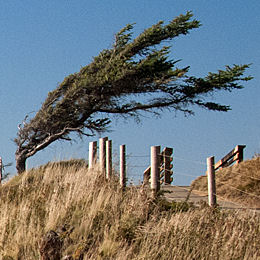
Sitka Spruce at Ecola State Park
© 2011 Ken Denniston